In this article
A shift ending at one time and another beginning later does not leave that whole interval free. Getting home, preparing food, attending to ordinary responsibilities and returning to work all occupy parts of it. A useful planning sketch starts with the window, then makes those claims visible. It is a way to inspect an invented day, not a test of whether a person can safely work a particular schedule.
Start with endpoints you can explain
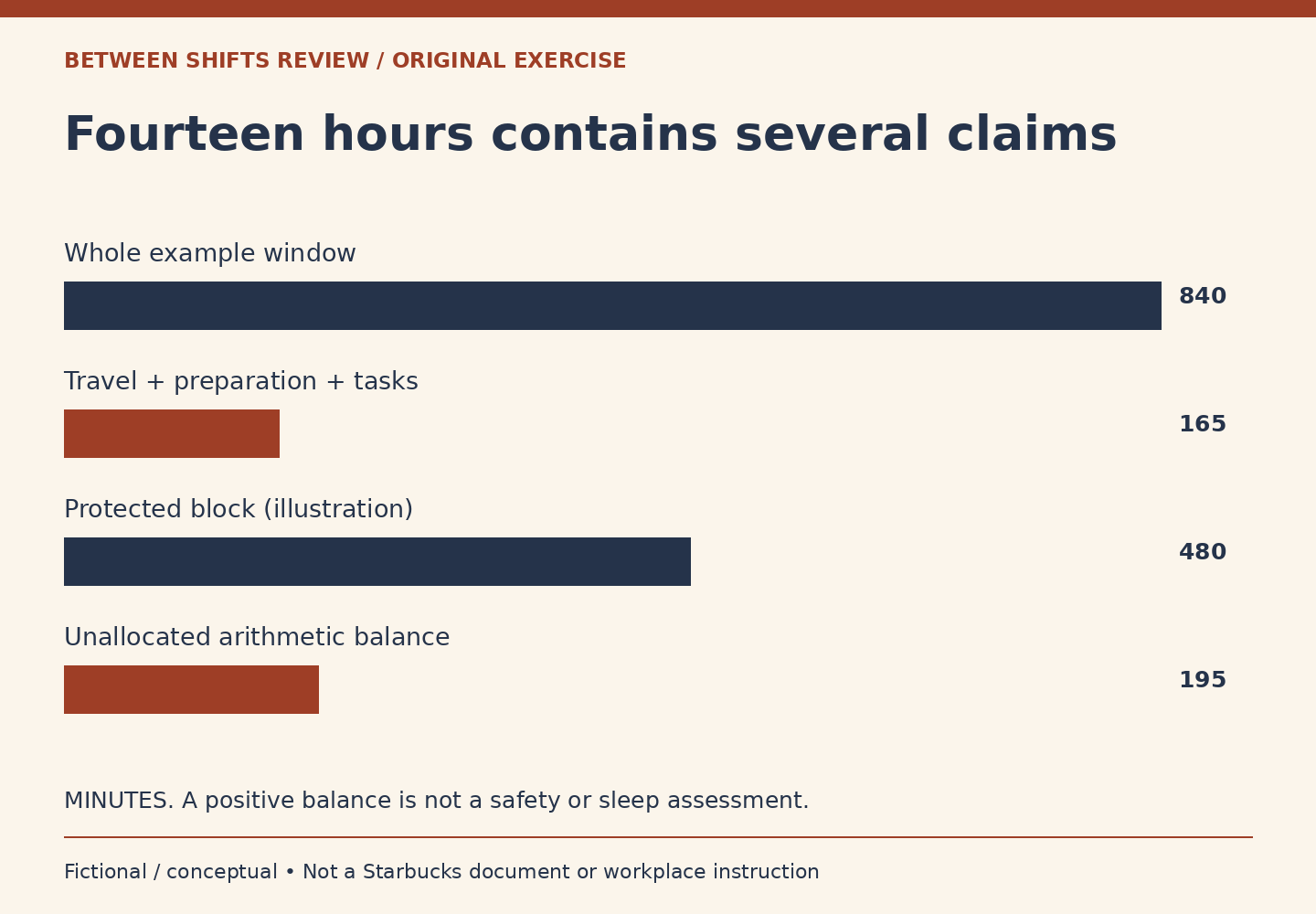
In a fictional example, the interval between two shifts is fourteen hours. This is 840 minutes. The person in the example needs thirty minutes to get home, thirty to return, forty-five to prepare to leave and sixty for other fixed tasks. Subtracting those 165 minutes leaves 675 minutes before any protected block is considered. Nothing about that arithmetic makes all 675 minutes restful or interchangeable.
The endpoints matter. A posted end time is not necessarily the moment someone reaches the street, and a start time is not an invitation to arrive late. Use the meaning of the times actually supplied through the workplace’s verified process. This publication does not redefine paid time, arrival requirements or any employer’s scheduling rules. If those meanings are unclear, resolve the question with the responsible workplace contact.
Reserve before you distribute
Suppose the invented plan includes a 480-minute protected block. The remaining arithmetic balance is 195 minutes. That balance is not a recommendation to fill every minute, and the protected block is not a medical sleep prescription. The example only shows the effect of putting a boundary into the calculation before discretionary tasks compete for it.
Now increase the return journey by forty minutes and the other tasks by thirty. The balance falls to 125. The calendar still contains fourteen hours between shifts, but the plan has changed. This is why a single large number can conceal the detail that matters. The Shift Window Sketch lets readers explore this arithmetic with invented numbers only.
Count a task once and name what is missing
Packing a bag during meal preparation might be one overlapping activity or two separate ones. Do not count the same minute twice, but do not assume every task can overlap. A bus ride may allow reading; it may also involve crowding, transfers or standing. The sketch treats entered blocks as separate. Its simplicity is a reason to examine assumptions, not evidence that real life fits neat rectangles.
List exclusions next to the example: no unexpected delay, no unplanned request, no change to the next shift and no extra travel. An excluded event is still possible. Instead of quietly squeezing the protected block when something changes, ask which commitment needs to move or which workplace question needs an answer. A calculation should expose a conflict rather than hide it.
Read a negative result correctly
If the entered blocks exceed the window, the model reports an over-allocation. It does not select which obligation to drop. A protected block cannot automatically become the adjustable remainder. Likewise, an extra shift cannot become reasonable merely because a spreadsheet turns positive after optimistic travel assumptions. The decision involves constraints this simple tool does not know.
NIOSH describes occupational fatigue as a shared workplace concern with multiple possible causes. That broader context is important: personal planning cannot compensate for every scheduling or workload problem. Use a private sketch to identify a specific question, such as whether a proposed timing leaves room for necessary travel. Keep health details and employment records out of public tools. For ongoing sleep problems or safety concerns, use the appropriate qualified or workplace support rather than relying on an arithmetic result.
Sources and limits
Fatigue and Work. Public material checked October 8, 2026. The exercise and fictional details are original editorial work. This article does not establish Starbucks policy, an entitlement or an individual health or legal conclusion.