In this article
A commute plan has at least two questions: how to arrive and what to do if the first plan stops working. A useful backup is specific enough to be usable under pressure. It does not need an elaborate map or a promise that every disruption can be solved. It needs a trigger, a feasible alternative and a way to communicate a material delay.
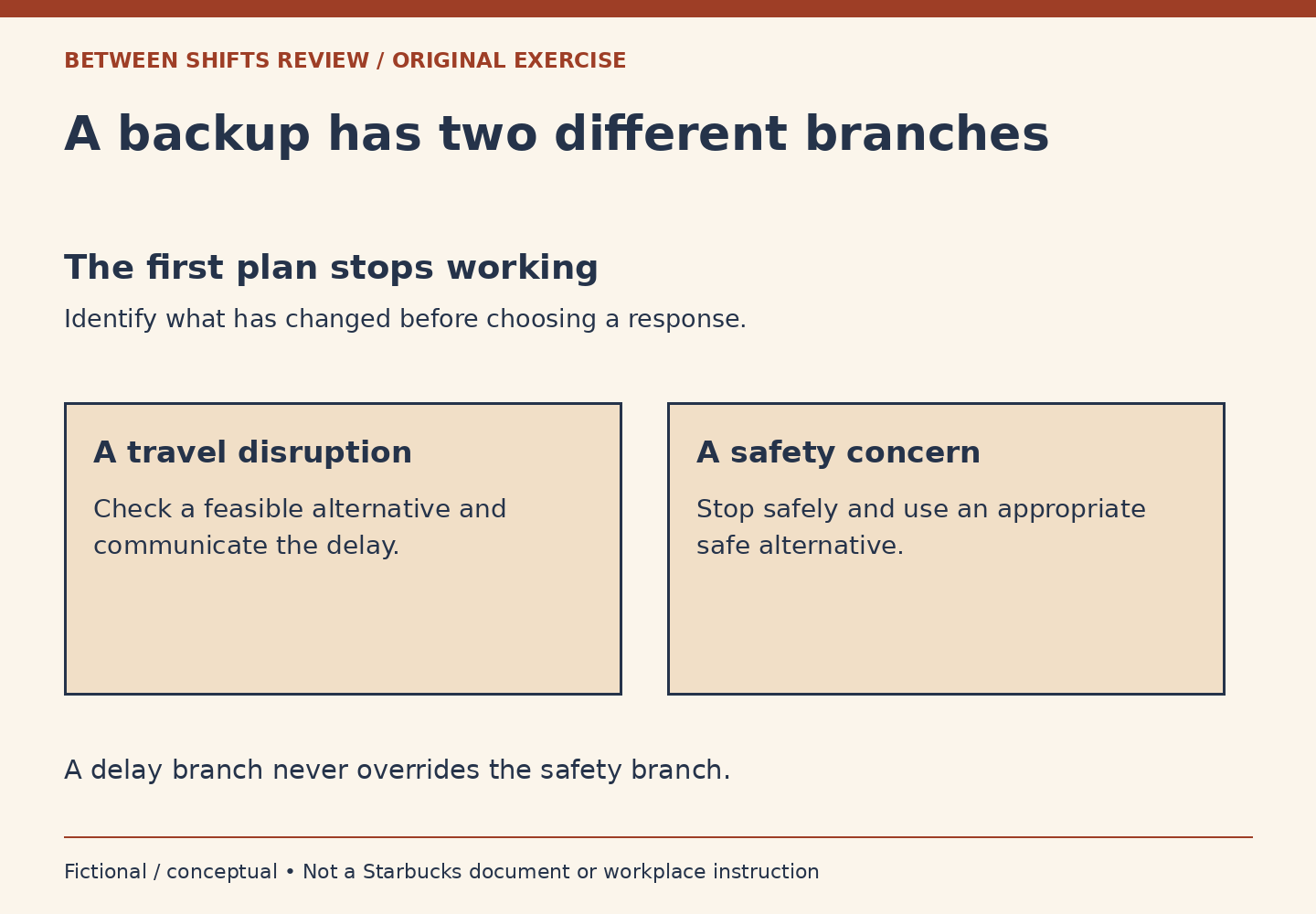
Name the weak link
In an invented example, a worker takes a bus that connects with a second route. The fragile point is the transfer, not the entire journey. Missing that connection adds twenty-five minutes. The next planning step is to check the transit operator’s current timetable and disruption notices, including the return service. This publication has not checked any reader’s route, fares or operating hours.
A car journey has different weak links: access to the vehicle, parking, weather and whether the driver can safely drive. A ride from another person depends on that person’s agreement. Do not call a possibility a backup until it is actually available. An unaffordable or unconfirmed ride is an unresolved option, not spare capacity.
Use a trigger rather than repeated guessing
A fictional trigger could be: “If the first service is cancelled before departure, check the operator’s posted alternative and notify the workplace through its required route if arrival changes.” Another might involve a closed road or an unavailable lift. The trigger identifies an event. It should not rely on constantly refreshing unrelated apps or on guessing how much delay a manager might tolerate.
The communication should describe what is known and what remains uncertain. “The service was cancelled; I am checking the next confirmed option” is clearer than offering an invented arrival time. Follow the actual workplace procedure for lateness or inability to attend. The examples here are not Starbucks reporting instructions and do not determine how any absence will be treated.
Safety is a separate branch
Being late and being unsafe to drive are not equivalent planning problems. NHTSA warns that drowsiness creates driving risk and that caffeine alone may not resolve it. A tight schedule is not a reason to continue driving while drowsy. If drowsiness develops, get to a safe place to stop and seek a safe alternative rather than trying to recover minutes by speeding or improvising while moving.
A time calculator cannot judge alertness, road conditions, a medical issue or the reliability of another driver. It should never produce a green “safe to drive” verdict. The window exercise accounts for travel minutes only. A positive arithmetic balance does not certify a journey or a shift pattern as safe.
Check the return journey too
A reliable outward service can coexist with a poor late return. In the fictional bus example, the evening timetable may have a different connection. Plan for the actual day of the week and any known service change. If the shift changes, revisit both directions rather than assuming the morning plan still applies.
Keep useful operator contact or route information somewhere accessible without publishing your address or routine. Do not post a detailed workplace schedule in a public forum to ask strangers for transport. If sharing a journey with someone you trust, send only the information needed for that arrangement. Privacy is part of making the backup dependable.
Test the plan while nothing is urgent
A calm review can uncover an outdated timetable, a phone with no charge or a backup that depends on someone who never agreed. The goal is not perfect control over travel. It is reducing avoidable uncertainty while recognizing the point where safety, official travel advice or workplace communication takes priority over arrival arithmetic.
Sources and limits
Drowsy Driving. Public material checked October 8, 2026. The exercise and fictional details are original editorial work. This article does not establish Starbucks policy, an entitlement or an individual health or legal conclusion.