In this article
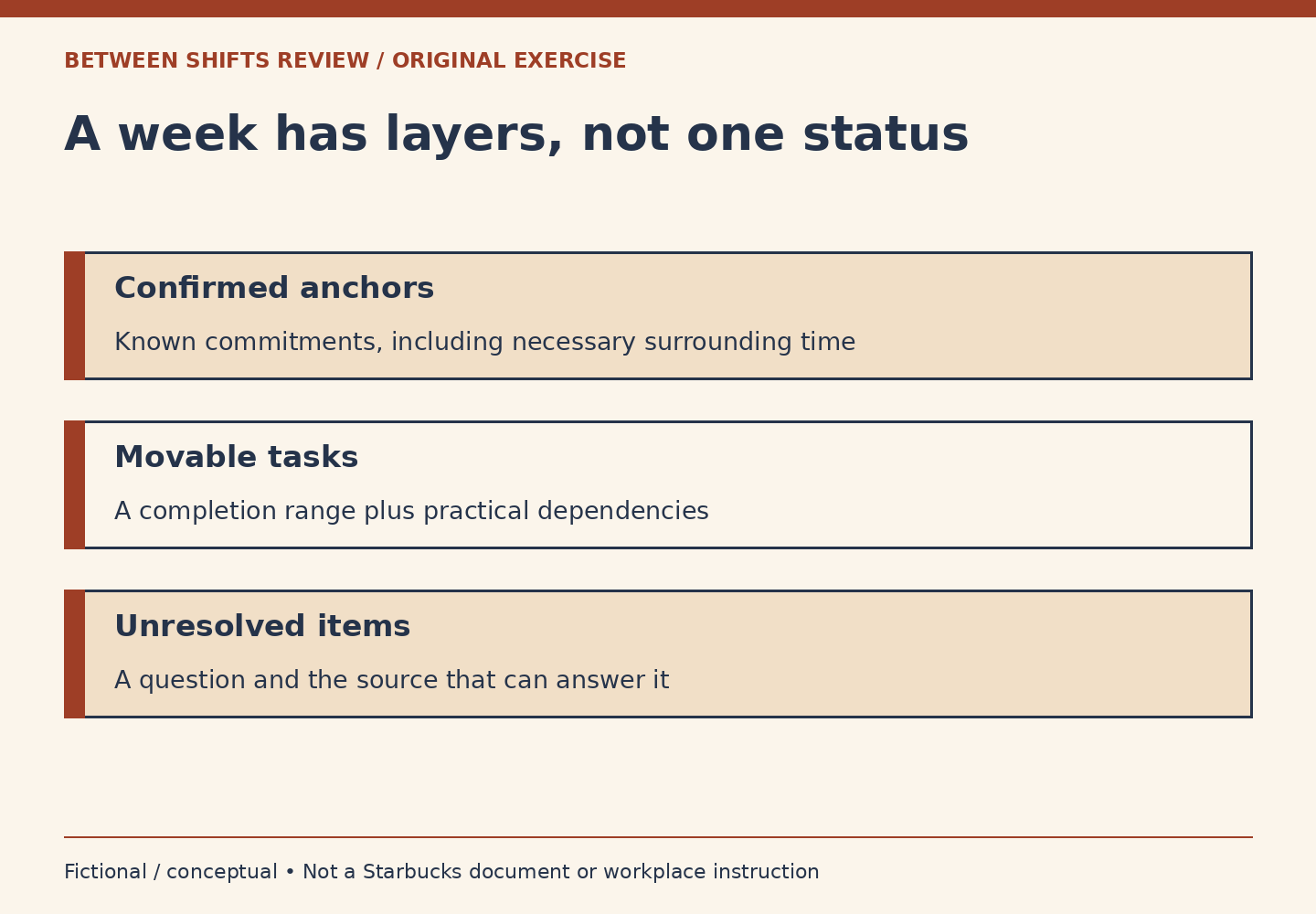
A repeating weekly template works only when the important parts of the week repeat. For shift-based service work, a layered plan can be more honest. Put confirmed commitments in one layer, movable personal tasks in another and unresolved items in a third. The result is a clearer picture of what can move and what still needs an answer.
Begin with confirmed anchors
In a fictional week, two shifts are confirmed and a third proposed change is pending. There is also one fixed appointment and an errand that can happen on either of two days. The confirmed shifts and appointment form the first layer. The pending change does not become an anchor until the employer’s authoritative process resolves it.
Travel and preparation belong beside each anchor, even when they are not separate appointments. A calendar showing only time at work can make the surrounding day appear deceptively open. Use the window method to inspect those claims without turning the result into a medical or scheduling-safety assessment.
Give movable tasks a range
A movable task needs more than a vague “sometime.” State its latest useful completion point and any practical dependencies. Grocery collection might require an available window; washing an item might need drying time. A task can be flexible within a range while still having constraints. That is different from assuming it can always be pushed to the next day.
For the invented errand, Monday afternoon and Wednesday morning are both possible. Mark the range rather than booking both. Once one slot is chosen, remove the other tentative hold. This simple step prevents a personal planning system from slowly filling with duplicate possibilities that look like real commitments.
Keep uncertainty in its own layer
Unresolved timing should remain visible without occupying every possible slot. Write the question and the source that can resolve it: a workplace schedule confirmation, a service appointment reply or another household member’s agreement. The next action is to get the missing information, not to solve an imaginary version of the week.
The public Starbucks coffeehouse careers page describes broad flexibility in scheduling. It does not guarantee that a particular personal template will be accommodated. The layered exercise is this publication’s original planning method and is not a Starbucks scheduling system, an employee policy or an account-navigation guide.
Look at adjacency, not just totals
Two weeks can have the same number of working hours and feel very different because the work sits differently among other commitments. A late finish followed by an early obligation raises different questions from two widely separated commitments. The issue is not only how many hours are occupied but which windows remain and what else must happen inside them.
This is a reason to inspect the actual sequence. It is not an invitation to declare a schedule safe from a diagram. If fatigue, health, rights or workplace safety is involved, use appropriate support and authoritative guidance. Personal calendar design cannot remove every consequence of a demanding pattern.
Leave a deliberate remainder
A plan with every minute allocated is fragile. Unallocated time may absorb an ordinary delay, allow a decision later or simply remain unassigned. Do not automatically rename it “wasted time.” The purpose of the plan is to make choices clearer, not to justify filling every space with a task.
At the next review, ask what changed rather than rebuilding everything from scratch. Confirm the anchors, move only the affected tasks and resolve the oldest pending question. A small revision is often easier to trust than a beautiful calendar that has fallen out of date. Keep personal copies private, avoid colleagues’ information and reconcile work details through the official process rather than treating this exercise as the source of truth.
Sources and limits
Starbucks Careers: Coffeehouses. Public material checked October 8, 2026. The exercise and fictional details are original editorial work. This article does not establish Starbucks policy, an entitlement or an individual health or legal conclusion.