In this article
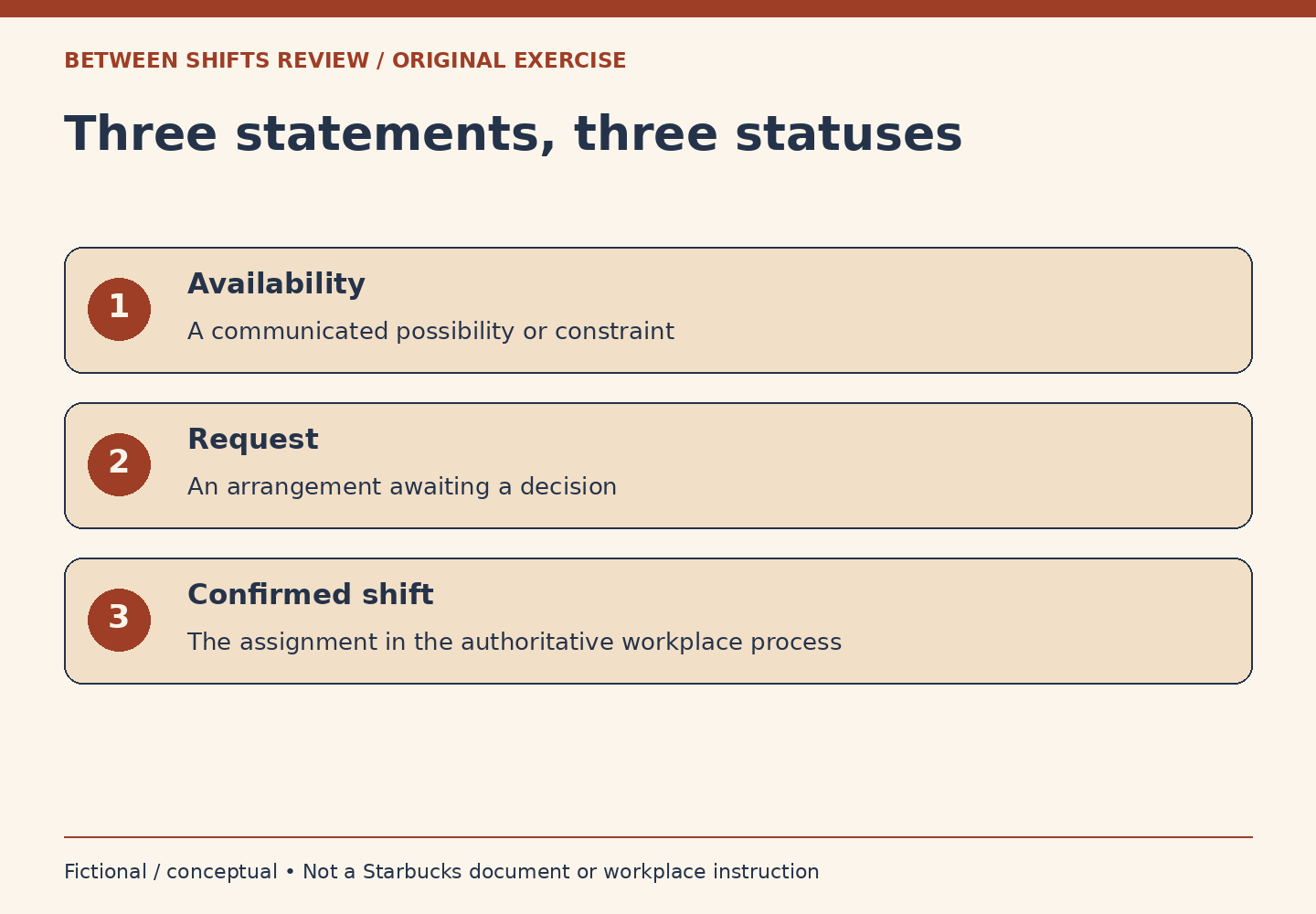
A calendar becomes confusing when three different statements share the same color. Being available to work, asking for a particular arrangement and receiving a confirmed shift are different events. Separating them reduces the chance that a household plan is built on an assumption. This is a communication exercise, not a guide to a particular scheduling application.
Give each statement a status
Availability describes a constraint or possibility that you have communicated. A request asks for an arrangement. A confirmed shift is the work assignment recorded through the employer’s authoritative process. The labels used at a real workplace may differ. What matters is checking which record controls and whether an acknowledgement means receipt or approval.
Consider a fictional worker who says that Tuesday afternoon is usually possible. Later, a friend asks to make plans on Tuesday. A blank personal calendar does not prove that the worker is free, just as stated availability does not prove that a shift will be assigned. The unresolved item is the actual schedule. Treating uncertainty as uncertainty avoids promising two people the same time.
Describe the constraint without oversharing
A useful request can contain the affected date or range, the boundary that matters and the desired response. It does not need a detailed account of family circumstances, medical history or private finances. If a formal accommodation or protected-leave issue exists, it may need a separate official process. Do not substitute a casual calendar note for that process or send sensitive documents to this publication.
For an invented practice sentence, try: “For the next planning period, my availability begins after the stated afternoon cutoff. Please confirm where to submit that update and when it takes effect.” This sentence identifies a boundary and asks how to make it operative. It does not announce approval, promise a result or assume a manager can ignore applicable requirements.
Keep receipt separate from resolution
A reply such as “I saw your note” may be helpful without settling the request. The next question is small: has the arrangement been approved, denied or left pending? Preserve the distinction in your own planning. A tentative entry can say “pending response” rather than borrowing the visual weight of a confirmed assignment.
The public Starbucks coffeehouse careers page discusses scheduling flexibility in broad terms. It does not establish a specific person’s working hours, guarantee approval of a request or explain every local scheduling process. Use that page for general employer context and the current verified workplace route for an actual arrangement. A marketing statement cannot substitute for a confirmed schedule.
Choose one place to reconcile changes
Personal copies are useful only if they are reconciled with the authoritative source. When a new schedule or correction is issued, compare the relevant dates and remove superseded tentative entries from the personal copy. Do not circulate screenshots containing colleagues’ details. A household usually needs your confirmed occupied periods, not a whole workplace roster.
A simple private review asks four questions: What is confirmed? What is pending? What has changed since the last check? Who else needs a limited update? This is not a requirement to monitor work messages continuously while off duty. Clarify the employer’s expectations and use the appropriate time and method for any work-related activity.
Leave room for a plain no
Sometimes a request cannot be accommodated, or a proposed change does not fit your constraints. Clear wording makes that outcome easier to understand. It also helps distinguish a communication failure from a disagreement. If the issue involves rights, pay or a safety concern, take it to the proper official channel. The editorial aim here is narrower: make the status visible before organizing the rest of a day around it.
Sources and limits
Starbucks Careers: Coffeehouses. Public material checked October 8, 2026. The exercise and fictional details are original editorial work. This article does not establish Starbucks policy, an entitlement or an individual health or legal conclusion.